
Curious about blockchain technology? Learn how it works, why it matters, and how it’s changing finance, healthcare, and the future of the internet. Read now!
Imagine a record book that no one person controls and that nobody can cheat, fake, or delete.
That’s blockchain technology in its simplest form. And it’s quietly rewriting the rules of how the internet, money, and trust work.
You’ve probably heard the word thrown around with Bitcoin, NFTs, or Web3. But blockchain is much bigger than any of those things. It’s the underlying infrastructure the engine under the hood that makes decentralized digital systems possible.
In this guide, we’re breaking down exactly what blockchain technology is, how it works step by step, and why it matters more in 2025 than ever before.
No jargon. No hype. Just clarity.
Pinterest Tip: Save this post for later it’s the most beginner-friendly breakdown of blockchain technology you’ll find online!
What Is Blockchain Technology? (Simple Definition)
At its core, a blockchain is a type of database.
But unlike a regular database which lives on a central server owned by one company a blockchain is distributed across thousands of computers worldwide. Every participant holds a copy of the same data.
Here’s what makes it special:
- Blocks Data is stored in units called “blocks”
- Chain Each block is linked to the one before it, forming a chain
- Distributed The chain lives on thousands of nodes simultaneously
- Immutable Once data is written, it cannot be changed or deleted
Think of it like a Google Doc that millions of people can read but no one can edit after it’s been saved. Every change gets a new entry, and the history is permanent.
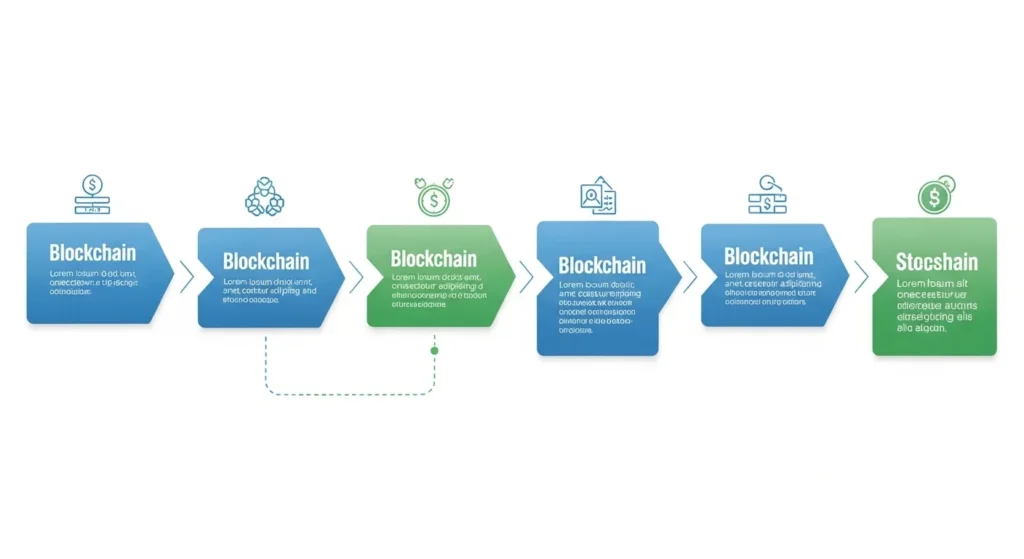
How Blockchain Technology Works Step by Step
This is the part most articles skip over. Let’s actually walk through what happens when data is added to a blockchain.
Step 1: A Transaction Is Initiated
Someone initiates an action let’s say sending 1 Bitcoin to a friend.
That transaction contains: sender’s address, receiver’s address, amount, and a timestamp. It’s broadcast to a peer-to-peer network of computers (called nodes).
Step 2: The Transaction Is Broadcast to the Network
Thousands of nodes across the globe receive this transaction request.
Each node has a full copy of the blockchain. They all work to verify whether the transaction is legitimate does the sender actually have the funds? Is the signature valid?
Step 3: Validation via Consensus Mechanism
This is where the magic happens.
Nodes must agree (reach consensus) that the transaction is valid before it gets added. There are two main ways this works:
Proof of Work (PoW)
- Miners race to solve a complex mathematical puzzle
- The winner adds the block and earns a reward
- Used by: Bitcoin
- Downside: Energy-intensive
Proof of Stake (PoS)
- Validators are chosen based on how much cryptocurrency they “stake” (lock up)
- More efficient and eco-friendly
- Used by: Ethereum (since 2022), Cardano, Solana
Step 4: The Block Is Created
Once validated, the transaction is bundled with other verified transactions into a block.
Each block contains:
| Field | What It Is |
|---|---|
| Block Header | Metadata about the block |
| Previous Hash | The unique ID of the block before it |
| Merkle Root | A fingerprint of all transactions in the block |
| Timestamp | When the block was created |
| Nonce | A number used in the mining process |
| Transaction Data | The actual records being stored |
Step 5: The Block Is Added to the Chain
The new block is cryptographically linked to the previous block using its hash a unique 64-character code.
Change even one character in an old block and its hash changes. That breaks the link to every block that followed it. This is why blockchain data is considered tamper-proof.
Step 6: The Transaction Is Complete
The updated blockchain is distributed to all nodes. Every copy across the world is synchronized.
The transaction is now permanent, public, and verifiable by anyone.
Understanding Blockchain Technology: Key Concepts You Must Know
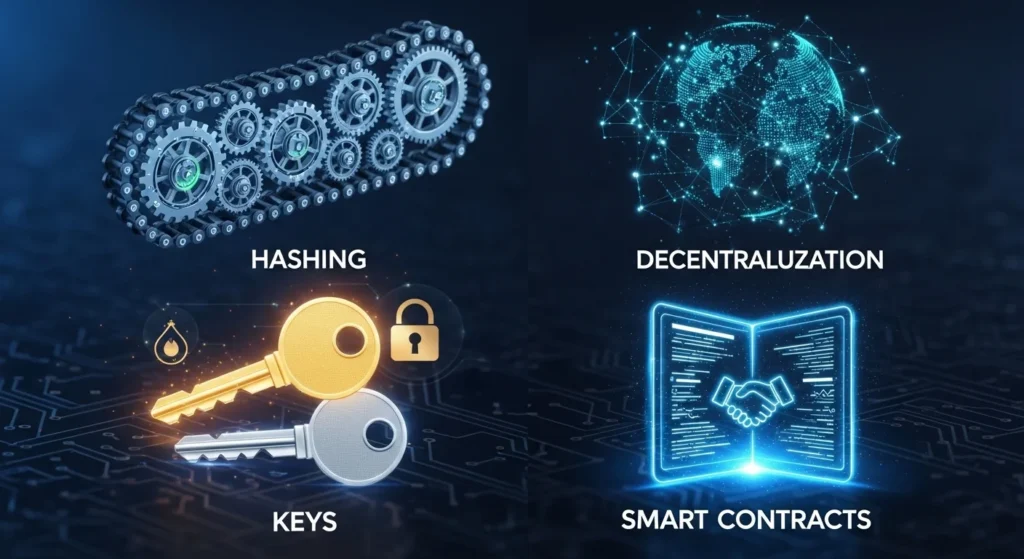
Let’s unpack the core technical ideas without making your brain hurt.
Cryptographic Hashing
Every block has a unique hash like a digital fingerprint generated by a mathematical function (SHA-256 for Bitcoin).
Feed in any data get a fixed-length string output. Change one letter in the input completely different output.
This makes it mathematically impossible to secretly alter historical records.
Decentralization
There is no CEO of Bitcoin. No head office. No single server.
The blockchain exists across thousands of independent nodes. If one goes offline, the others continue. If someone tries to corrupt one copy, the network rejects it because it doesn’t match the other 9,999 copies.
Public and Private Keys
Every blockchain user has two keys:
- Public Key Like your email address. Share it freely. People use it to send you assets.
- Private Key Like your password. Never share it. Used to sign and authorize transactions.
Lose your private key? No recovery. No customer support. That’s the tradeoff for true ownership.
Smart Contracts
A smart contract is a self-executing program stored on the blockchain.
It says: “IF condition A is met, THEN automatically execute action B.”
No middleman. No lawyer. No bank. Just code.
Example: A smart contract for a property sale automatically transfers ownership and releases funds to the seller the moment both conditions are verified simultaneously, in seconds.
Types of Blockchain Networks
Not all blockchains are the same. Here are the four main types:
1. Public Blockchain
- Open to everyone
- Fully decentralized
- Examples: Bitcoin, Ethereum
- Best for: Cryptocurrency, open finance
2. Private Blockchain
- Controlled by one organization
- Faster and more efficient
- Examples: Hyperledger Fabric
- Best for: Internal business processes
3. Consortium Blockchain
- Shared control between a group of organizations
- Semi-decentralized
- Examples: R3 Corda, Quorum
- Best for: Banking networks, supply chains
4. Hybrid Blockchain
- Mix of public and private
- Flexible and scalable
- Examples: Dragonchain
- Best for: Enterprises needing selective transparency
Real-World Applications of Blockchain Technology
This is where it gets exciting. Blockchain isn’t just about crypto.
Here’s where it’s already being used right now, in the real world:
Finance and Banking
- Cross-border payments in seconds (vs 3–5 business days)
- Decentralized Finance (DeFi) banking without banks
- Instant settlement of trades
- Fraud reduction through immutable audit trails
Example: Ripple (XRP) is used by major banks to process international transfers in 3–5 seconds.
Healthcare
- Secure sharing of patient records between hospitals
- Drug supply chain verification (fighting counterfeit medications)
- Clinical trial data integrity
Example: IBM’s blockchain network helps pharmaceutical companies track drug shipments from factory to pharmacy.
Supply Chain & Logistics
- Real-time tracking of goods from origin to destination
- Proof of authenticity for luxury goods and food
- Automatic customs clearance via smart contracts
Example: Walmart uses blockchain to trace food contamination sources in seconds a process that used to take weeks.
Voting Systems
- Tamper-proof digital voting records
- Transparent election auditing
- Increased voter accessibility
Several countries including Estonia and Sierra Leone have tested blockchain-based voting systems.
NFTs and Digital Ownership
- Proof of ownership for digital art, music, collectibles
- Royalty automation via smart contracts
- Decentralized marketplaces
Blockchain Technology vs Traditional Database: Key Differences
Still wondering why blockchain is better than a regular database? Here’s the honest comparison:
| Feature | Traditional Database | Blockchain |
|---|---|---|
| Control | Centralized (one authority) | Decentralized (many nodes) |
| Data Editing | Can be changed anytime | Immutable once written |
| Transparency | Limited / private | Public or permissioned |
| Trust Model | Trust the institution | Trust the code |
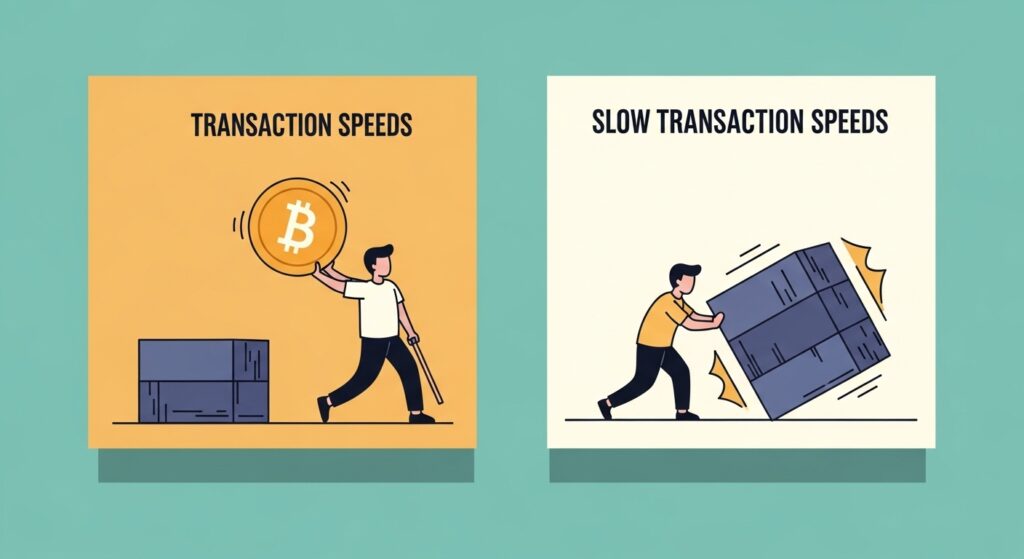
| Speed | Very fast | Slower (consensus required) |
| Security | Vulnerable to single-point attack | Highly resistant to tampering |
| Cost | Low infrastructure cost | Higher computation cost |
The honest truth? Blockchain isn’t better than databases in every situation. For internal business data with no need for transparency or decentralization, a regular database is faster and cheaper.
Blockchain shines when trust between multiple parties is the core problem.
The Challenges and Limitations of Blockchain
Let’s be honest blockchain isn’t perfect.
Here are the real challenges the industry is still working through:
- Scalability Bitcoin processes ~7 transactions per second. Visa handles 24,000. This gap is being addressed by Layer 2 solutions like Lightning Network.
- Energy Consumption Proof of Work blockchains like Bitcoin consume enormous amounts of electricity. Ethereum’s switch to Proof of Stake reduced its energy use by 99.95%.
- Complexity Developing on blockchain requires specialized knowledge. The barrier to entry for developers is still high.
- Regulation Governments worldwide are still figuring out how to regulate decentralized systems. Legal uncertainty slows enterprise adoption.
- Interoperability Different blockchains don’t naturally talk to each other. Cross-chain communication is still an evolving challenge.
The Future of Blockchain Technology
Where is blockchain headed in the next 5–10 years?
Web3 The next generation of the internet built on blockchain, giving users ownership of their data and digital assets rather than Big Tech.
Central Bank Digital Currencies (CBDCs) Over 130 countries are actively exploring government-issued digital currencies on blockchain infrastructure.
AI + Blockchain Combining AI’s intelligence with blockchain’s trust layer creates powerful systems for automated, verifiable decision-making.
Decentralized Identity Blockchain-based digital IDs could replace passwords and government documents — giving individuals full control over their personal data.
DeFi Maturity Decentralized Finance is moving from experimental to institutional, with major banks and funds entering the space.
The technology is still early. The infrastructure is still being built. But the direction is clear: blockchain is becoming the trust layer of the digital world.
Conclusion
Blockchain technology is one of the most significant innovations of the 21st century not because of any single application, but because of what it fundamentally changes: how strangers trust each other online.
Here’s what you now understand:
- A blockchain is a distributed, immutable ledger shared across thousands of nodes
- Data is stored in cryptographically linked blocks that can’t be altered
- Consensus mechanisms like Proof of Work and Proof of Stake ensure integrity without central authority
- It has real-world applications in finance, healthcare, supply chain, voting, and digital ownership
- It has genuine limitations scalability, energy, regulation that are actively being solved
- The future points toward Web3, CBDCs, DeFi, and decentralized identity
You don’t need to invest in crypto to understand blockchain. You need to understand it because it’s going to affect how every industry stores, shares, and verifies information in the coming decade.
What blockchain application excites you most? Comment below or save this guide to Pinterest to revisit whenever blockchain comes up in conversation!
Frequently Asked Questions (FAQs)
What is blockchain technology in simple terms?
Blockchain technology is a type of digital record book that stores data in linked blocks across thousands of computers simultaneously. No single person or company controls it, and once data is written, it cannot be changed making it transparent, secure, and trustworthy by design.
Is blockchain the same as Bitcoin?
No. Bitcoin is a cryptocurrency that runs on a blockchain. Blockchain is the underlying technology think of it as the internet, and Bitcoin as one website. Thousands of other cryptocurrencies, applications, and systems also run on blockchain technology.
Is blockchain technology secure?
Blockchain is considered highly secure because of its cryptographic hashing, decentralized structure, and consensus mechanisms. To alter any record, an attacker would need to simultaneously control more than 50% of all network nodes which is practically impossible on large public blockchains like Bitcoin or Ethereum.
Can blockchain be hacked?
The blockchain protocol itself has never been successfully hacked on major networks. However, the surrounding ecosystem crypto exchanges, wallets, and smart contracts has been exploited due to software bugs and human error. The lesson: blockchain security is strong, but your personal security practices matter too.
What industries will blockchain disrupt the most?
The industries with the most to gain from blockchain technology include banking and finance (removing intermediaries), healthcare (secure data sharing), supply chain (end-to-end transparency), government (voting, identity, land registries), and media (creator royalties through NFTs and smart contracts).