

Discover the 12 essential Python tools for AI and deep learning in 2024. Master PyTorch, TensorFlow, JAX, Hugging Face, and other advanced libraries to build, train, and deploy cutting-edge AI models efficiently.
Introduction: The Python-Powered AI Revolution
The symbiotic relationship between Python and the field of artificial intelligence is one of the key drivers of the current technological revolution. The language’s simplicity, readability, and vast ecosystem of specialized libraries have made it the undisputed lingua franca for AI research and development. However, as models grow more complex and datasets become larger, the demand for more sophisticated Python Tools has escalated.
Moving beyond foundational libraries like NumPy and Scikit-learn, the modern AI practitioner must be proficient with a new generation of Python Tools designed for scalability, efficiency, and production readiness. This article explores twelve advanced Python Tools that are pushing the boundaries of what’s possible in AI and deep learning, providing the capabilities needed to build, train, deploy, and monitor state-of-the-art models in 2024.
The evolution of these Python Tools reflects several key trends: the move from static computation graphs to dynamic ones, the rise of end-to-end machine learning pipelines, the critical importance of model interpretability, and the need for robust deployment and monitoring systems. Python Tools Mastering this advanced toolkit is no longer optional for professionals who aim to implement AI solutions that are not just academically interesting, but also robust, efficient, and impactful in real-world scenarios.
1. PyTorch 2.0: The Dynamic Deep Learning Powerhouse
Core Concept and Philosophy:
PyTorch’s ascendancy to the top of the deep learning framework hierarchy is rooted in its philosophy of imperative programming, also known as “eager execution.” Unlike its predecessors that used static computation graphs (where the entire model is defined as a graph before execution), Python Tools PyTorch builds the graph on-the-fly as operations are executed. This makes the debugging process intuitive and Pythonic—you can use standard Python tools like print() and pdb to inspect tensors and track down errors at any point in your model, just as you would with any other Python code.
Technical Deep Dive: PyTorch 2.0 and torch.compile
While eager execution is fantastic for development, it can be less performant than pre-compiled graphs for production. PyTorch 2.0’s flagship feature, torch.compile, is a groundbreaking solution. It acts as a just-in-time (JIT) compiler. You can wrap your model or a function with compiled_model = torch.compile(model). Python Tools When this function is called, PyTorch traces its execution, captures the operations into a graph, and then uses deep learning compilers (like TorchDynamo and TorchInductor) to optimize this graph for the target hardware (CPU, GPU). This provides a massive speedup—often 1.5x to 2x—without forcing you to leave the flexible, eager-mode environment for development. It’s the best of both worlds.
Ecosystem and Practical Application:
PyTorch is not an island; it’s the center of a vast ecosystem.
- TorchVision, TorchText, TorchAudio: These Python Tools domain-specific libraries provide not only pre-trained models (ResNet, BERT, Wav2Vec2) but also common datasets and data transformation utilities, drastically reducing boilerplate code.
- Distributed Training: PyTorch offers robust support for data-parallel and model-parallel training across multiple GPUs and nodes via
torch.nn.parallel.DistributedDataParallel. This is essential for training large language models or vision transformers on massive datasets. - Production Ready: Tools like TorchScript allow you to export models from Python to a serialized format that can be run in high-performance C++ environments, which is critical for mobile and embedded deployment Python Tools .
Why it’s Indispensable: PyTorch 2.0 strikes the perfect balance between research flexibility and production performance, backed by the most vibrant research community, making it the default starting point for most new deep learning projects.
2. TensorFlow & Keras 3.0: The Scalable Production Framework
Core Concept and Philosophy:
TensorFlow was built with scalability and production deployment as its primary design goals. Its initial use of static computation graphs, defined using its own API, allowed for powerful global optimizations and efficient execution Python Tools across a wide array of platforms, from data centers to mobile phones. While this made debugging more challenging, the trade-off was unparalleled deployment versatility.
Technical Deep Dive: The Keras Integration and Multi-Backend Future
The integration of Keras as TensorFlow’s high-level API was a strategic masterstroke. Keras provides a user-friendly, modular, and extensible interface for building neural networks. Instead of defining low-level tensor operations, you can simply stack layers
like tf.keras.layers.Dense() and tf.keras.layers.Conv2D(). This dramatically lowered the barrier to entry. The recent release of Keras 3.0 is a monumental shift. It is now a multi-backend framework. You can write your model once using the Keras API and then choose to run it on top of TensorFlow, JAX, or PyTorch. This decouples the model definition from the execution engine, giving teams unprecedented flexibility Python Tools to switch backends based on their performance or deployment needs without rewriting code.
Ecosystem and Practical Application:
- TensorFlow Extended (TFX): This is TensorFlow’s crown jewel for production. TFX is an end-to-end platform for deploying production ML pipelines. It provides components for data validation, preprocessing, Python Tools model training, evaluation, and serving, all orchestrated to create a robust, automated, and monitored system.
- Deployment Everywhere: TensorFlow Lite is optimized for on-device inference on mobile and edge devices, while TensorFlow.js enables models to run directly in a web browser. TensorFlow Serving is a dedicated, high-performance system for serving models in a server environment.
- TF.Data API: This API provides a highly efficient way to build complex input pipelines from large datasets stored on disk, handling crucial aspects like parallel I/O, prefetching, and shuffling.
Why it’s Indispensable: For enterprises building large-scale, reliable, and end-to-end ML systems that need to be maintained for years, TensorFlow’s comprehensive and battle-tested production ecosystem is often the safest Python Tools and most powerful choice.
3. JAX: The Composable Function Transformer
Core Concept and Philosophy:
JAX takes a fundamentally different approach. It is not a neural network library but a “accelerated numerical computation” library. Its core idea Python Tools is that of “composable function transformations.” It provides a NumPy-like API for array manipulation, but its power comes from pure, composable functions that transform these NumPy functions.
Technical Deep Dive: The Transformers
JAX’s magic lies in a few key functions:
jax.grad(f): Automatically computes the gradient of functionf. You can compose this to get higher-order derivatives (e.g.,jax.grad(jax.grad(f))for a Hessian).jax.jit(f): Compiles the functionfusing XLA (Accelerated Linear Algebra), resulting in dramatically faster execution, especially on GPUs and TPUs.jax.vmap(f): Automatically vectorizes a functionfwritten for a single example, so it can efficiently process a batch. Python Tools This eliminates the need for manual batch dimension handling.jax.pmap(f): Parallelizes a functionfacross multiple accelerator devices (e.g., multiple GPUs or TPU cores).
The beauty is that these transformations can be arbitrarily composed. For example, jax.jit(jax.grad(f)) gives you a JIT-compiled gradient function.
Ecosystem and Practical Application:
JAX itself is low-level. Libraries like Flax and Haiku build neural network abstractions on top of it.
- Flax: Provides a full-featured, PyTorch-like neural network library with a focus on flexibility and clarity.
- Haiku: Developed by DeepMind, it offers a simpler, more modular approach to building neural network components.
JAX excels in research areas that require maximum performance and customizability, such as:
- Reinforcement Learning: Where novel agent architectures and loss functions are common.
- Scientific Machine Learning: Physics-Informed Neural Networks (PINNs), molecular dynamics.
- New Architecture Research: Building transformers or other models from scratch with unique components.
Why it’s Indispensable: For researchers pushing the absolute boundaries of performance or working on non-standard model architectures, Python Tools JAX provides a level of control and speed that is unmatched by higher-level frameworks.
4. Hugging Face transformers: The NLP Democratizer
Core Concept and Philosophy:
The transformers library was built to eliminate the massive duplication of effort in the NLP community. Before its existence, using a Python Tools state-of-the-art model like BERT required downloading someone’s implementation, figuring out their preprocessing, and adapting it to your task. Hugging Face created a unified, consistent API for thousands of pre-trained models.
Technical Deep Dive: The Pipeline Abstraction and Model Hub
The library’s power is best exemplified by its pipeline API, which abstracts away the entire process:
python
from transformers import pipeline
classifier = pipeline("sentiment-analysis")
classifier("I love using Hugging Face transformers!")
In three lines, this code downloads a pre-trained model, its tokenizer, and runs inference. For more control, you can easily load a specific model and tokenizer:
python
from transformers import AutoTokenizer, AutoModelForSequenceClassification
tokenizer = AutoTokenizer.from_pretrained("distilbert-base-uncased-finetuned-sst-2-english")
model = AutoModelForSequenceClassification.from_pretrained("distilbert-base-uncased-finetuned-sst-2-english")
The Auto classes let you switch models by just changing the model name. The Hugging Face Hub hosts these models, Python Tools creating a central repository for the community.
Ecosystem and Practical Application:
- Easy Fine-Tuning: The
Trainerclass handles the entire training loop, including distributed training, mixed-precision, and logging. You just need to provide the model, tokenizer, and dataset. - Integration with
datasets: The sister library,datasets, provides efficient access to thousands of public datasets, Python Tools which can be fed directly into theTrainer. - Beyond NLP: While focused on NLP, the library has expanded to include vision and audio models (e.g., CLIP, Whisper).
Why it’s Indispensable: It has dramatically lowered the barrier to entry for state-of-the-art NLP, allowing developers and researchers to build powerful applications in minutes rather than months.
5. Lightning AI PyTorch Lightning: The Engineering Abstraction Layer
Core Concept and Philosophy:
PyTorch Lightning addresses a critical problem: PyTorch code for complex projects can become messy, unstructured, and difficult to reproduce. It introduces a lightweight wrapper around PyTorch that enforces a strict and logical separation of concerns.
Technical Deep Dive: The LightningModule and Trainer
Instead of writing a monolithic script, you organize your code into a LightningModule:
__init__(): Define your model architecture.forward(): Define the inference step.training_step(): Define the logic for a single training step (forward pass, loss calculation).configure_optimizers(): Define your optimizers and schedulers.
Once your logic is defined, the Trainer object takes over:
python
trainer = L.Trainer(max_epochs=10, accelerator="gpu", devices=2)
trainer.fit(model, train_dataloaders=train_loader)
The Trainer is a single entry point to a universe of advanced features. Want to use 16-bit precision? Add precision=16. Want to train on 8 GPUs? Change devices=8. It handles all the engineering boilerplate—device placement, Python Tools gradient accumulation, checkpointing, logging—so you can focus purely on the research.
Ecosystem and Practical Application:
- Reproducibility: The structured code is inherently more reproducible and shareable.
- Production & Research Bridge: It makes research code “production-ready” by enforcing good software engineering practices.
- Lightning Fabric: A newer, even lighter-weight tool that gives you fine-grained control over the training loop while still automating the engineering complexity.
Why it’s Indispensable: It is the most effective tool for scaling PyTorch code from a single-GPU experiment to a multi-node, production-grade training run without losing sanity.
6. Weights & Biases: The Experiment Tracking Hub

Core Concept and Philosophy:
Machine learning is fundamentally experimental. Keeping track of which hyperparameters, code versions, and data produced which result is a monumental challenge. Python Tools Weights & Biases (W&B) solves this by providing a centralized “laboratory notebook” for your team’s ML experiments.
Technical Deep Dive: Automatic Logging and Visualization
Integration is simple: import wandb and initialize a run with wandb.init(project="my-project"). From there, you can log almost anything:
- Metrics:
wandb.log({"loss": loss, "accuracy": acc})logs metrics over time, creating live-updating graphs. - Hyperparameters:
wandb.config.update({"learning_rate": 0.01, "batch_size": 32})saves the configuration of your run. - Media: Log images, audio, and text outputs to see model predictions visually.
- System Metrics: Automatically tracks GPU/CPU utilization and memory usage.
Ecosystem and Practical Application:
- Sweeps: This is a killer feature for hyperparameter optimization. You define a search strategy (e.g., random, Bayesian) and the parameter space, and W&B automatically launches and manages parallel runs to find the best configuration.
- Artifacts: For versioning datasets, models, and other outputs. This creates a lineage, so you can always know which model was trained on which data.
- Reports: Collaborative documents where you can embed live plots and summaries from your runs to share findings with stakeholders.
Why it’s Indispensable: It brings scientific rigor and collaboration to ML development, turning a chaotic process into a structured, auditable, and reproducible workflow.
7. MONAI: Medical AI Specialization

Core Concept and Philosophy:
Applying standard computer vision tools to medical images (CT, MRI, X-Ray) is often inadequate and can lead to incorrect results. MONAI is a PyTorch-based framework that provides domain-specific tools for healthcare imaging, ensuring that best practices are built-in.
Technical Deep Dive: Domain-Specific Transforms and Metrics
The key differentiator is in its data transformations. A standard image library might rotate an image, but a 3D medical volume must be rotated Python Tools correctly to preserve anatomical spatial relationships. MONAI provides transforms like Rand3DRotate that handle this correctly. It also offers:
- Specialized Loss Functions: Losses like Dice loss are standard for medical image segmentation, where class imbalance is severe (e.g., a small tumor in a large organ).
- Network Architectues: Pre-built, state-of-the-art architectures optimized for 3D data, like UNet, DynUNet, and SegResNet.
- Federated Learning: Tools to train models across multiple hospitals without centralizing sensitive patient data, a critical feature for healthcare.
Why it’s Indispensable: For any AI project in the medical domain, using MONAI is not just a convenience—it’s a necessity to ensure the validity, safety, and ethical compliance of your models.
8. Ray: The Scalable Distributed Compute Framework
Core Concept and Philosophy:
Ray provides a simple and universal API for parallelizing Python workloads across a cluster of machines. It abstracts away the immense complexity of distributed systems, allowing you to scale your code from a laptop to a large cluster with minimal changes.
Technical Deep Dive: Core Primitives and ML Libraries
Ray’s power comes from two simple primitives:
@ray.remote: A decorator that turns a Python function into a “remote function” that can be executed asynchronously on any worker in the cluster.futures = [f.remote(i) for i in range(100)]runs 100 tasks in parallel.ray.put(): Places a large object (like a dataset) in the cluster’s shared-memory “object store” so all workers can access it efficiently without copying.
On top of this core, Ray builds a full ML ecosystem:
- Ray Tune: A hyperparameter tuning library that can run thousands of trials in parallel, far surpassing the capabilities of single-machine tools.
- Ray Train: Manages distributed training for PyTorch, TensorFlow, and others.
- Ray Serve: A scalable model serving solution Python Tools that lets you deploy models as microservices with ease, handling load balancing and scaling automatically.
Why it’s Indispensable: It is the most straightforward path to taking a Python prototype and turning it into a distributed, scalable application, making it essential for large-scale AI.
9. FastAPI: The Modern Model Deployment Engine
Core Concept and Philosophy:
FastAPI is a modern web framework for building APIs with Python. Its speed, ease of use, and automatic documentation make it the ideal choice for wrapping ML models in a production-ready web service.
Technical Deep Dive: Type Hints, Pydantic, and ASGI
FastAPI leverages Python type hints for everything. When you define your request and response data models using Python’s standard types,Python Tools FastAPI and Pydantic (the data validation library underneath) automatically:
- Validate Data: Ensure that incoming JSON requests have the correct fields and data types.
- Generate Documentation: Automatically creates an interactive OpenAPI (Swagger) documentation page for your API.
- Provide Editor Support: Because of the type hints, code editors can offer autocompletion and error checking.
It’s built on ASGI (Asynchronous Server Gateway Interface), which allows it to handle a very high number of concurrent requests efficiently—a perfect fit for serving model inference endpoints that might experience variable load.
Why it’s Indispensable: It allows data scientists and engineers to create robust, self-documenting, and high-performance model APIs with minimal code, bridging the gap between a trained model and a consumable service.
10. SHAP & Captum: The Model Interpretability Suites
Core Concept and Philosophy:
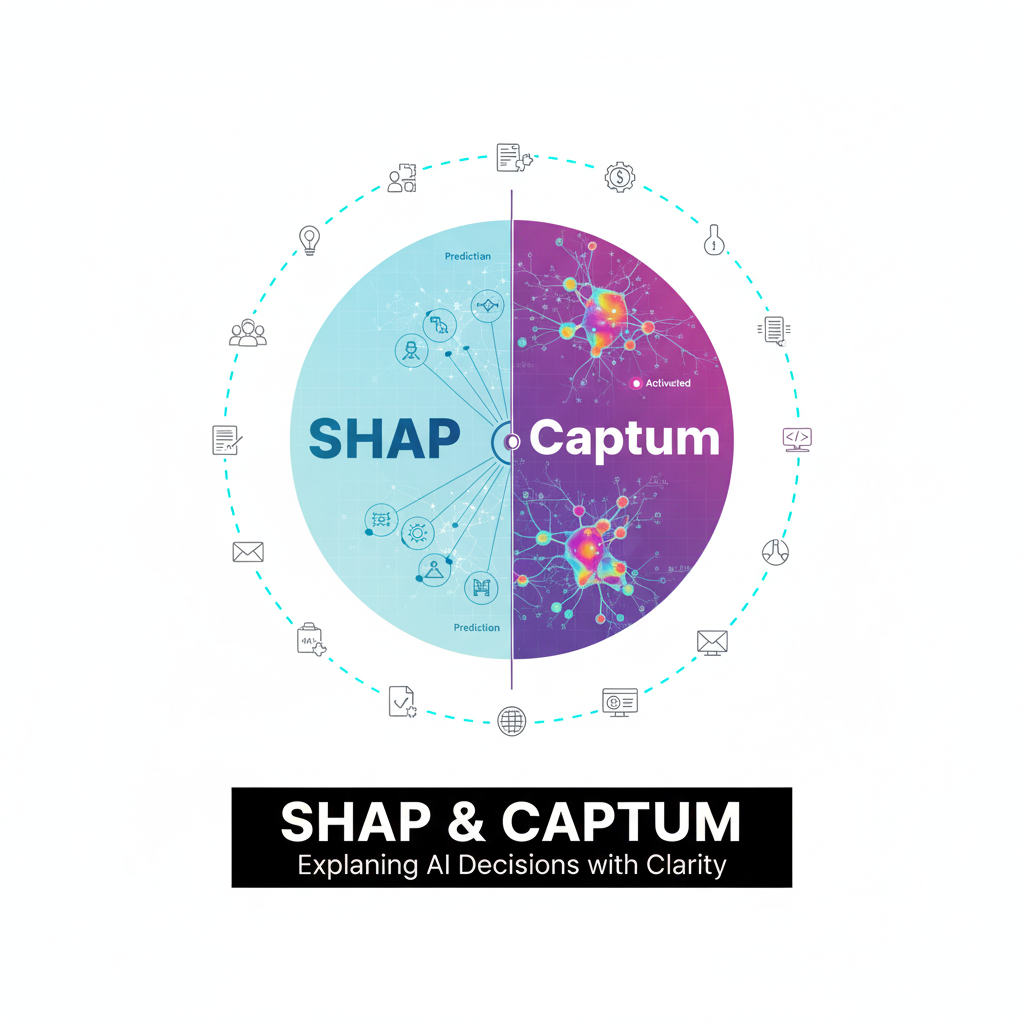
To trust and debug complex “black box” models, we need tools to explain their predictions. SHAP and Captum use principles from cooperative game theory to assign a consistent and theoretically sound “importance value” to each input feature for a given prediction.
Technical Deep Dive: Shapley Values and Attribution Methods
The core idea is the Shapley value. It fairly distributes the “payout” (the prediction) among the “players” (the input features). For a given Python Tools input, SHAP calculates how much each feature contributed to the difference between the actual prediction and the average prediction.
- SHAP: Model-agnostic. It can explain any model by using approximations (like KernelSHAP) or model-specific methods (like TreeSHAP for tree-based models).
- Captum: PyTorch-native. It provides a wider array of attribution methods specifically designed for deep networks, such as Integrated Gradients (which accumulates the gradient along a path from a baseline to the input) and DeepLIFT.
These tools produce visualizations that answer the question: “Why did my model make this specific prediction?”
Why it’s Indispensable: They are essential for building trust, meeting regulatory requirements, debugging model bias, and ensuring that Python Tools models are making decisions for the right reasons.
11. Numba & CuPy: The High-Performance Computing Accelerators
Core Concept and Philosophy:
These tools allow you to write high-level Python code that executes at speeds comparable to C/C++/Fortran, by targeting CPUs and GPUs directly.
Technical Deep Dive:
- Numba: A Just-In-Time (JIT) compiler. You decorate a function with
@numba.jit. Numba analyzes the function’s bytecode and compiles it to optimized machine code at runtime. It’s exceptionally good for speeding up numerical loops and mathematical operations that NumPy can’t vectorize. - CuPy: A drop-in replacement for NumPy that uses the CUDA platform to execute operations on an NVIDIA GPU. By simply Python Tools replacing
npwithcp, your array operations (matrix multiplications, etc.) are automatically offloaded to the GPU, resulting in orders-of-magnitude speedups for large-scale linear algebra.
Why it’s Indispensable: When you hit a performance bottleneck in your data preprocessing or custom algorithms that pure Python/NumPy can’t handle, Numba and CuPy provide a path to massive acceleration without leaving the Python ecosystem.
12. MLflow: The End-to-End MLOps Platform
Core Concept and Philosophy:
MLflow is an open-source platform for managing the complete machine learning lifecycle. It addresses the challenge of taking models from Python Tools experimentation to production in a reproducible, traceable, and collaborative way.
Technical Deep Dive: The Four Components
- Tracking: A logging API and UI to record experiments (parameters, metrics, code versions, artifacts). It’s the foundational layer for reproducibility.
- Projects: A packaging format for Python Tools reproducible data science code. An MLproject file defines its environment (Conda, Docker) and how to run it.
- Models: A packaging format for models. It allows you to save a model in a standard format that can be loaded and used by different downstream tools, regardless of which library (sklearn, PyTorch, etc.) was used to train it.
- Model Registry: A centralized hub for collaboratively managing the full lifecycle of an MLflow Model. It provides stage transitions (e.g., Staging -> Production), versioning, and annotations.
Why it’s Indispensable: MLflow provides the essential “glue” that connects the disparate stages of the ML workflow. It is the foundational Python Tools tool for implementing MLOps practices, ensuring that model development is not a chaotic art but a disciplined engineering process.