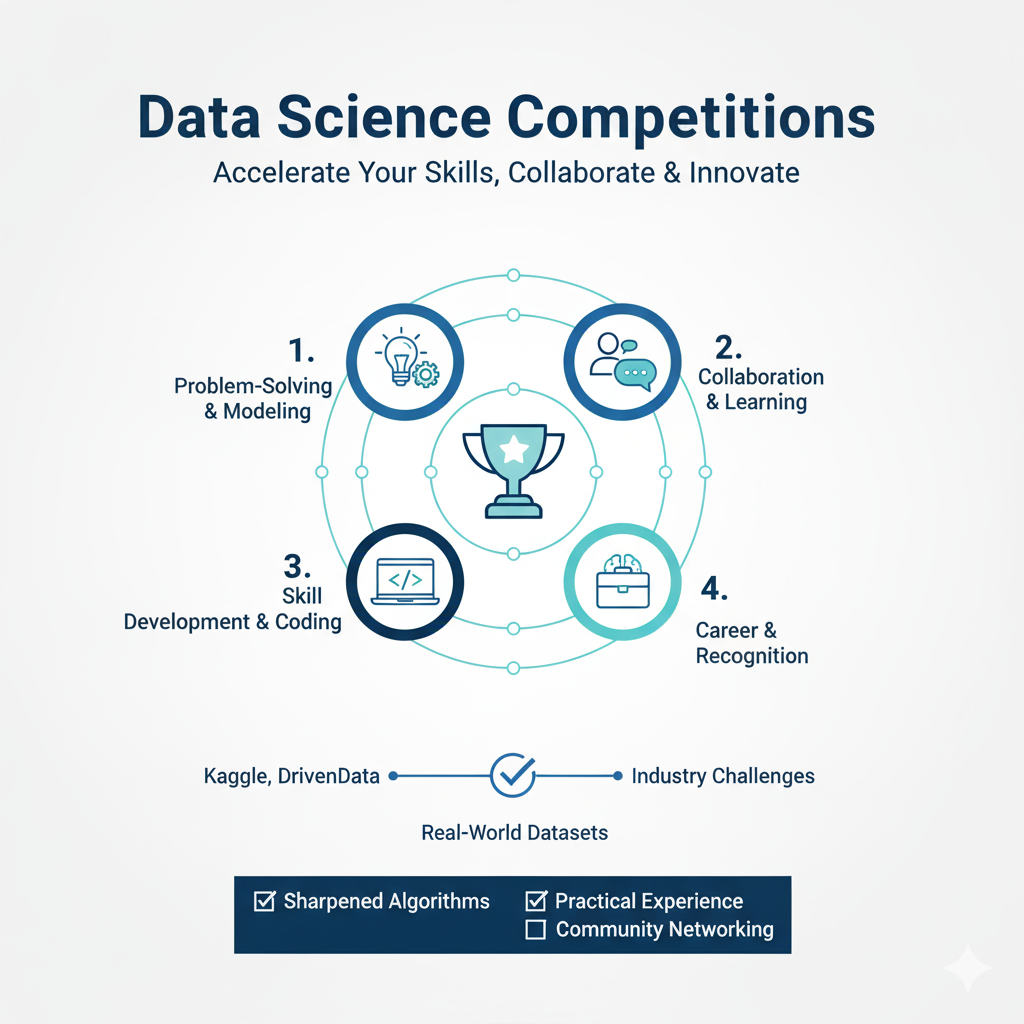
Start your Data Science Competitions journey with these beginner-friendly competitions in 2025. Learn practical skills, build your portfolio, and join a global community of aspiring AI professionals through hands-on machine learning challenges.
Introduction: Why Your First Competition is a Career Catalyst
In the rapidly evolving field of data science, theoretical knowledge of Python, statistics, and machine learning algorithms is merely the price of admission. The true differentiator—the skill that transforms an aspiring student into a job-ready candidate—is practical experience. This is precisely where Data Science Competitions become indispensable. For a beginner in 2025, engaging in these.
Data Science Competitions is the most effective way to bridge the gap between classroom learning and the messy, ambiguous challenges of the real world. These platforms provide a risk-free environment to test theories, fail, learn, and ultimately, build a robust portfolio that speaks louder than any certificate. This article serves as your strategic guide to navigating the world of Data Science Competitions, focusing on the three premier platforms—Kaggle, Zindi, and DrivenData—and outlining a curated list of beginner-friendly contests that will fast-track your journey to becoming a proficient data scientist.
The Competitive Landscape: An Overview of Key Platforms
Before diving into specific contests, it’s crucial to understand the unique value proposition of each major platform hosting Data Science Competitions.
The landscape of Data Science Competitions is rich and varied, with different platforms catering to distinct motivations, from pure skill-building to direct social impact. Understanding the core identity of each major platform is crucial for beginners to choose where to invest their time and intellectual energy.
Kaggle: The Colossal Gymnasium for the Global Data Community
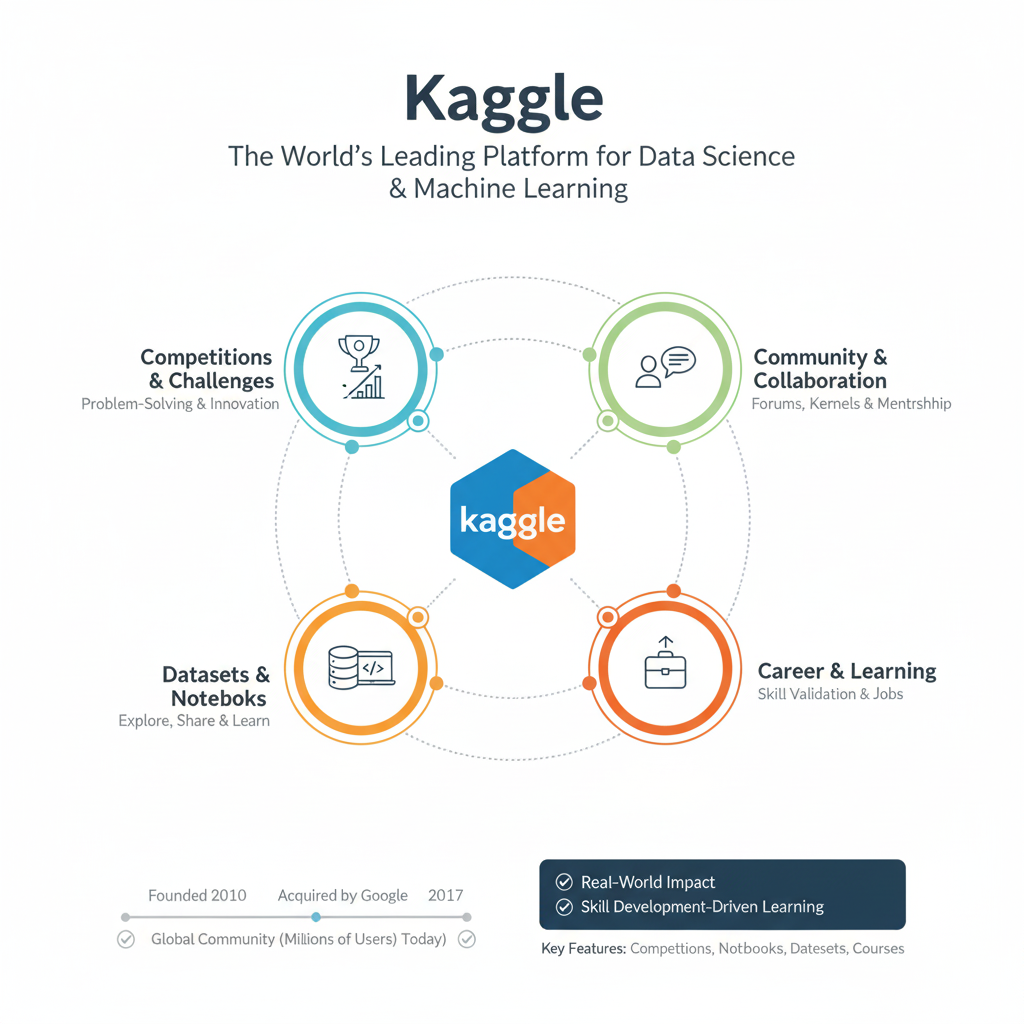
When one thinks of Data Science Competitions, Kaggle is almost synonymous with the term. Owned by Google, it functions as a comprehensive gymnasium for data scientists of all levels, but it is particularly engineered for the beginner’s journey.
- The “Undisputed Giant”: Kaggle’s scale is its defining feature. It hosts thousands of active Data Science Competitions at any given time, ranging from permanent, tutorial-like “Getting Started” competitions to high-stakes, corporate-sponsored contests with prize pools in the hundreds of thousands of dollars. This volume ensures there is always a challenge that matches a beginner’s skill level and interest.
- A Structured Path for Learning: For a novice, Kaggle is more than a competition site; it’s an interactive university. Its “Learn” section offers micro-courses on everything from Python and Pandas to deep learning. This integrated approach allows you to learn a concept in a tutorial and immediately apply it in a low-stakes competitive environment.
- The Power of the Collective: Notebooks and Discussions: This is Kaggle’s “secret sauce.” Every competition features a vibrant ecosystem of shared Public Notebooks and Discussion forums.
- Notebooks: These are full, executable code environments where top performers and enthusiasts share their entire workflow. A beginner can “fork” a notebook, run it to see the result, and then deconstruct it line-by-line to understand the methodology, from data cleaning to advanced feature engineering and model stacking. This is akin to having thousands of mentors providing free, practical code reviews.
- Discussions: The forums are where strategic debates happen. Participants ask clarifying questions about the data, share preliminary findings, and discuss the pitfalls of different approaches. For a beginner, lurking in these discussions is a masterclass in the thought process of data science.
- Value for Beginners: Kaggle Data Science Competitions provides a safe, resource-rich environment to fail and learn. The pressure is low in beginner competitions, and the support system is vast. Success on Kaggle is a highly respected credential that signals practical proficiency to employers worldwide.
Zindi: The Engine for Pan-African Problem-Solving
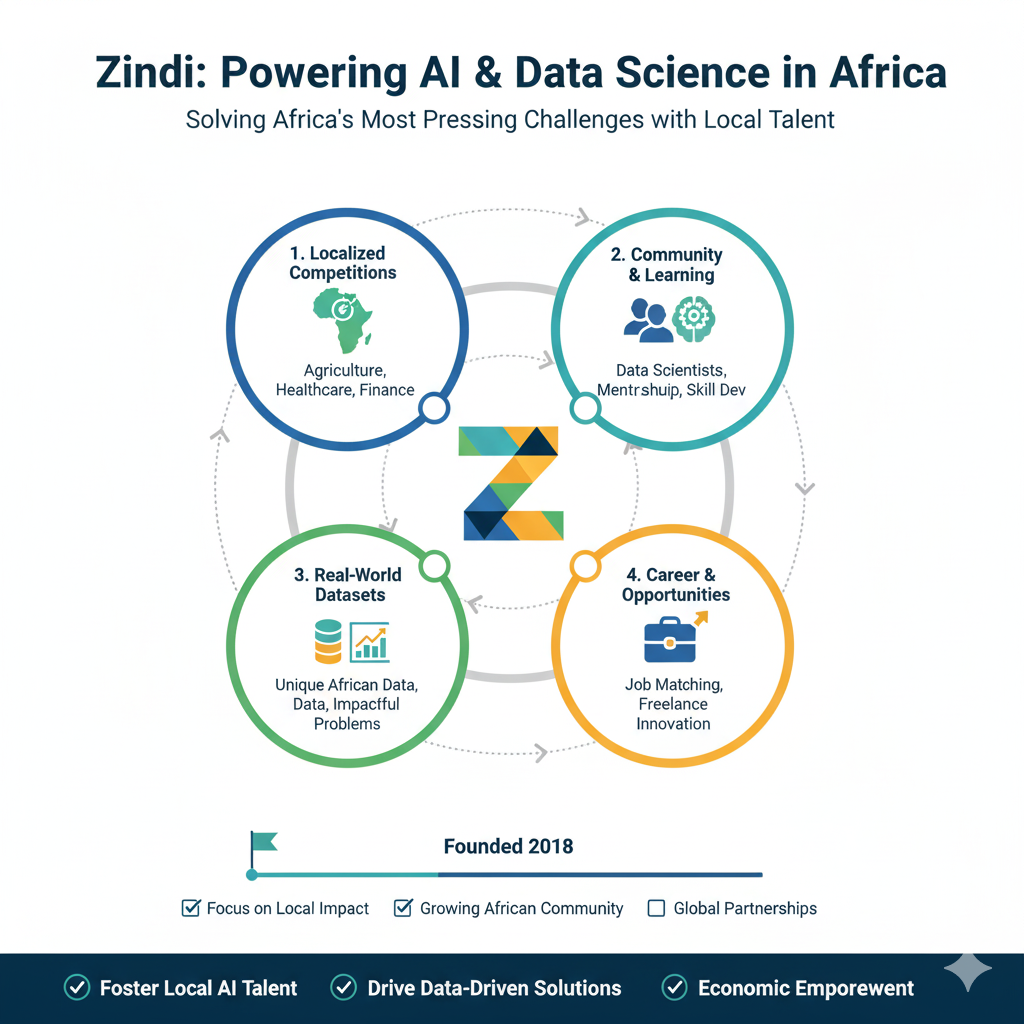
Zindi has carved out a vital and unique niche in the world of Data Science Competitions by focusing squarely on the African continent. It moves beyond abstract challenges to tackle tangible, on-the-ground issues.
- Mission-Driven Competitions: The Data Science Competitions on Zindi are not academic exercises. They are commissioned by NGOs, government agencies, and companies facing real problems. A competition might involve predicting crop yields from satellite imagery to improve food security, classifying the condition of road networks, or optimizing energy distribution. This direct line from your model to potential real-world impact provides a powerful motivation.
- A Collaborative and Growing Community: While all platforms have communities, Zindi’s is notably collaborative and focused on capacity building. There is a strong emphasis on uplifting the data science ecosystem within Africa. The platform hosts regular workshops, webinars, and mentorship programs. For a beginner, this creates a supportive atmosphere that feels less intimidating and more like a collective mission.
- Access to Unique and Relevant Datasets: Zindi provides access to data that is often unavailable elsewhere—datasets on local languages, agricultural patterns, mobile money transactions, and urban infrastructure specific to African contexts. Working with this data builds a highly specialized and valuable skill set.
- Value for Beginners: Zindi is ideal for beginners who are motivated by purpose. It demonstrates how Data Science Competitions can be a force for good. Participating here allows you to build a portfolio that is not just technically sound but also rich in narrative, showing a commitment to applying data for positive change.
DrivenData: The Impact Lab for the Common Good
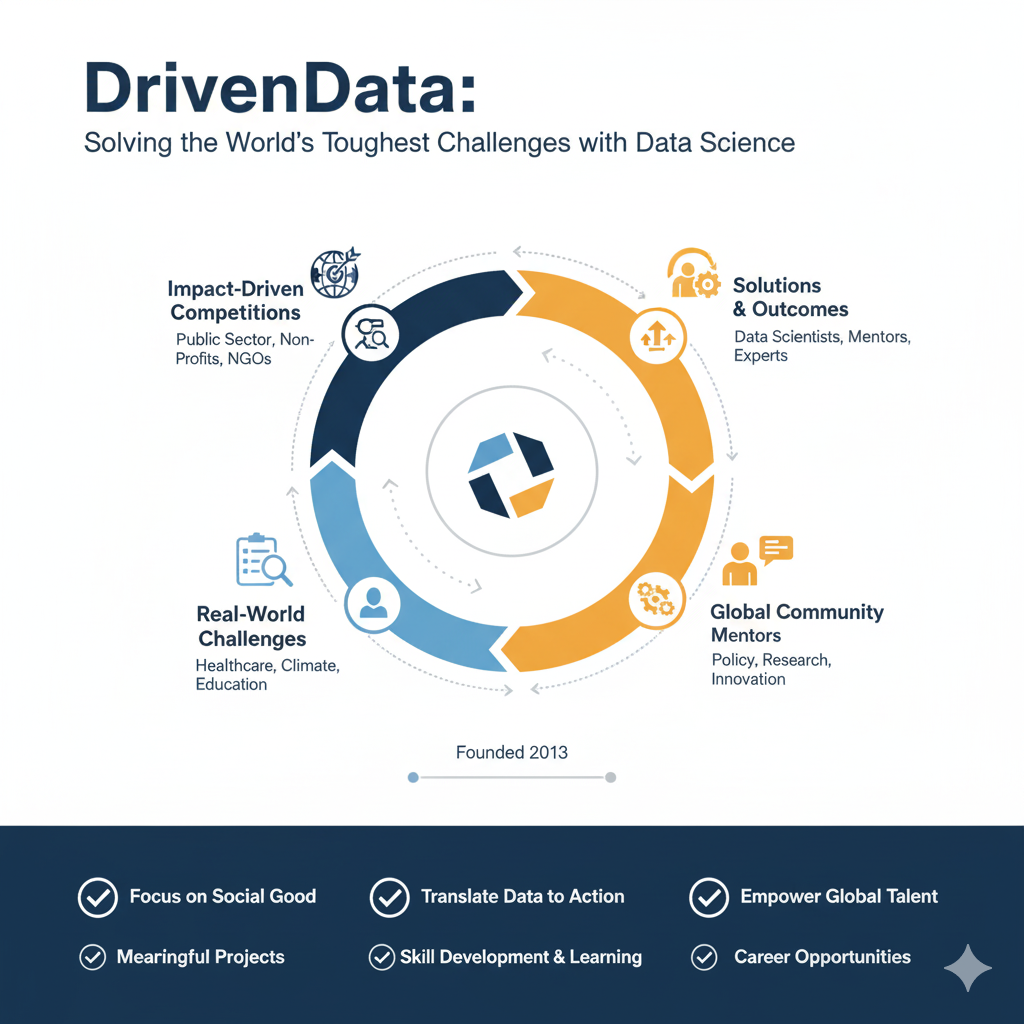
DrivenData operates at the intersection of data science and humanitarian work. It is the definitive platform for individuals who want to use their skills explicitly for social good, partnering with non-profits, research institutions, and public sector organizations.
- A Curated Portfolio of Purpose: The Data Science Competitions on DrivenData are meticulously selected for their potential to contribute to the UN Sustainable Development Goals. You will find challenges related to conserving biodiversity, improving educational outcomes in underserved communities, predicting disease outbreaks, and ensuring climate justice. The problem statements are compelling and underscore the human need behind the data.
- Emphasis on Explainability and Practicality: While performance matters, the solutions generated in DrivenData Data Science Competitions are often intended for deployment in resource-constrained environments. This places a premium on models that are not only accurate but also interpretable, robust, and feasible to implement. This teaches a crucial, often-overlooked skill: building models for the real world, not just for a leaderboard.
- A Community of Changemakers: The community on DrivenData is comprised of data scientists who are passionate about specific cause areas. The discussions are often less about hyper-optimizing a model and more about the domain context: “What does this feature actually mean for a community health worker?” This deep, domain-specific learning is an invaluable part of the experience.
- Value for Beginners: DrivenData offers a profound sense of purpose. For a beginner, it provides a clear answer to the question, “What is data science for?” Participating in these Data Science Competitions builds a portfolio that showcases both technical ability and ethical commitment, a combination highly attractive to mission-driven companies and organizations.
In summary, while all three platforms host exceptional Data Science Competitions, they offer different flavors of experience. Kaggle is the ultimate training ground and professional proving floor. Zindi is the platform for applying data science to unique, continent-specific challenges with a collaborative spirit. DrivenData is the impact lab for those dedicated to using data as a tool for humanitarian and environmental progress. A well-rounded beginner would benefit from experiencing the unique value each one provides
Data Science Competitions Every Beginner Should Tackle in 2025
1. Titanic: Machine Learning from Disaster (Kaggle)
The Challenge: This is the quintessential “Hello, World!” of Data Science Competitions. The goal is to build a predictive model that answers the question: “what sorts of people were more likely to survive?” using passenger data like age, gender, socio-economic class, and more.
Why it’s a Must-Join for Beginners:
- Foundational Workflow: It perfectly introduces the end-to-end machine learning pipeline: data loading, exploratory data analysis (EDA), feature engineering, model training (e.g., Random Forest), and submission.
- Community Learning: Thousands of public notebooks and forum discussions allow you to deconstruct the approaches of top performers, making it a guided learning experience.
- Low Barrier to Entry: The dataset is small and manageable, requiring no specialized hardware.
Skills You’ll Master: Python (Pandas, Scikit-learn), EDA, basic feature engineering, binary classification, and model evaluation.
2. House Prices: Advanced Regression Techniques (Kaggle)
The Challenge: A step-up in complexity, this competition tasks you with predicting the final sale price of homes based on 79 features describing everything from lot size to basement condition.
Why it’s a Must-Join for Beginners:
- Introduction to Regression: Shifts your focus from classification to a fundamental regression problem, teaching you new evaluation metrics like Root Mean Squared Error (RMSE).
- Real-World Data Handling: The dataset contains missing values, skewed distributions, and numerous categorical variables, forcing you to master essential data cleaning and preprocessing techniques Data Science Competitions.
- Feature Engineering Focus: Success hinges on your ability to create and select meaningful new features from the raw data.
Skills You’ll Master: Data imputation, handling categorical variables (one-hot encoding), advanced feature engineering, and powerful regression algorithms like XGBoost and LightGBM.
3. UmojaHack Africa (Zindi)
The Challenge: Zindi’s flagship annual hackathon for students and young data scientists in Africa. It typically features multiple challenges across different domains, such as financial inclusion, agriculture, and mobility.
Why it’s a Must-Join for Beginners:
- Social Impact Focus: You apply your skills to solve authentic, high-impact problems relevant to the African context.
- Collaborative Spirit: These hackathons foster a strong sense of community and are designed for learning and networking.
- Diverse Problem Types: You might tackle anything from image classification for crop disease to time-series forecasting for electricity demand, providing broad exposure.
Skills You’ll Master: Adapting to new problem domains, working under time constraints, and applying ML to unique, impactful datasets.
4. Predicting Poverty with Drivendata (DrivenData)
The Challenge: A classic DrivenData competition that involves using satellite imagery and survey data to estimate poverty levels in regions where direct data is scarce Data Science Competitions.
Why it’s a Must-Join for Beginners:
- Multi-Modal Data: Introduces you to the challenge of combining different data types (images and tabular data), a highly valuable skill.
- Meaningful Problem: The work you do has a direct connection to humanitarian efforts and policy-making.
- Clear Benchmarks: DrivenData competitions often provide well-defined benchmarks and thorough problem descriptions, making them very beginner-accessible.
Skills You’ll Master: Working with geospatial data, feature extraction from images, and building models for socio-economic prediction.
5. Digit Recognizer (Kaggle)
The Challenge: A classic computer vision problem: Data Science Competitions correctly identify digits from a dataset of tens of thousands of handwritten images.
Why it’s a Must-Join for Beginners:
- Gateway to Deep Learning: This is the perfect excuse to build your first neural network. While simple models can work, you’ll see a massive performance jump by implementing a basic Convolutional Neural Network (CNN).
- Introduction to Image Data: It teaches you how to handle and preprocess image data, a foundational skill for any field involving computer vision.
- Direct Link to Core AI: It connects you to one of the historical problems that helped launch the deep learning revolution.
Skills You’ll Master: Image data preprocessing, building neural networks with Keras/TensorFlow/PyTorch, and introductory CNNs.
Your Strategic Game Plan for 2025 Competitions
Success in Data Science Competitions requires more than just technical skill; it demands a strategy.
This five-point strategy is not just a to-do list; it’s a philosophical approach to effective learning and problem-solving in data science. Adhering to this methodology will ensure you extract maximum value from every competition you enter.
1. Start with EDA: The Foundation of All Insight
The command to “never skip Exploratory Data Analysis (EDA)” is fundamental because EDA is the process of listening to what your data has to say before you start shouting instructions at it with complex models Data Science Competitions.
- What it Really Means: EDA is a systematic investigation of your dataset. It involves using statistical summaries and visualization tools to understand the underlying structure, spot anomalies, test hypotheses, and check assumptions.
- Concrete Actions:
- Understand Dimensions and Types: How many rows and columns? What are the data types (numeric, categorical, text)?
- Check for Missingness: Use heatmaps and summary statistics to locate missing values. Is the missingness random, or is there a pattern?
- Analyze Distributions: Plot histograms and boxplots for numerical features. Are they normally distributed, or skewed? This influences which models might work best and whether you need transformations.
- Uncover Relationships: Create correlation matrices and scatterplots. How do variables relate to each other and to the target variable you’re trying to predict?
- Why it’s Critical: Skipping EDA is like building a house without surveying the land. You might build a beautiful model that is fundamentally flawed because it’s based on a misunderstanding of the data’s quirks, Data Science Competitions such as hidden outliers, leakage, or imbalanced classes. EDA provides the context and intuition that guide every subsequent decision.
2. Establish a Baseline: The North Star for Your Progress
The instruction to “quickly create a simple model” is a discipline that prevents wasted effort and provides a crucial frame of reference.
- What it Really Means: A baseline model is a deliberately simple, often “dumb” model whose performance serves as a minimum viable threshold. Your entire project’s goal is to build something that is significantly better than this starting point.
- Concrete Actions:
- Choose Simplicity: For a classification problem, this could be a Logistic Regression or a Dummy Classifier that always predicts the most frequent class. For regression, a Linear Regression or simply predicting the mean/median of the target variable.
- Use Minimal Feature Engineering: At this stage, use the raw or minimally cleaned data. The goal is speed, not sophistication.
- Record the Score: Note the performance metric (e.g., Accuracy, F1-Score, RMSE) from your first submission. This number is your baseline.
- Why it’s Critical: Without a baseline, you have no objective measure of improvement. A complex model might take a week to build and achieve a 75% accuracy. But if a simple model achieved 74% in one hour, the complex model’s value is questionable. The baseline quantifies your progress and helps you decide if a new, complicated feature engineering idea is actually worth the effort.
3. Embrace the Iterative Cycle: The Engine of Improvement
The “EDA -> Feature Engineering -> Model Training -> Submission -> Analysis -> Repeat” loop is the core workflow of a data scientist. It champions incremental progress over monolithic, “big-bang” solutions.
- What it Really Means: Instead of trying to build one perfect model that does everything, you build a simple pipeline and then make small, measurable improvements in each cycle.
- Breakdown of the Loop:
- EDA (Again): As you engineer new features, you must re-explore the data to understand their impact.
- Feature Engineering: This is often the most impactful step. Create a few new features (e.g., combining existing ones, extracting date parts, grouping rare categories).
- Model Training: Train your model (starting with your simple baseline model) on the new set of features.
- Submission & Analysis: Submit the predictions and analyze the result. Did your score improve? On which part of the data (public vs. private leaderboard) did it improve or worsen? Use this analysis to form a hypothesis for the next cycle.
- Why it’s Critical: This agile approach prevents “paralysis by analysis.” It allows for rapid experimentation and learning. Each iteration is a small experiment that tests a hypothesis, providing immediate feedback and a clear direction for the next step.
4. Learn Publicly: The Superpower of Open Platforms
The advice to “study the winning solutions and public notebooks” is about leveraging the collective intelligence of the community, which is the single greatest advantage of platforms like Kaggle, Zindi, and DrivenData.
- What it Really Means: After you have pushed your own approach as far as you can, it’s time for a masterclass. The top performers on the leaderboard almost always share their code and methodology.
- Concrete Actions:
- Find the “Solutions” Thread: After a competition ends, there is almost always a forum thread where winners explain their approach.
- Fork and Deconstruct Notebooks: Find high-ranking public notebooks. Don’t just run them; study them line by line. Ask yourself: Why did they use that specific feature? What library is that function from? Data Science Competitions How did they handle missing data differently?
- Identify Reusable Techniques: You will discover powerful feature engineering tricks, novel uses of algorithms, and data preprocessing libraries you never knew existed. Add these techniques to your personal toolkit.
- Why it’s Critical: This is accelerated learning. You are essentially being tutored by the world’s best data scientists, learning the cutting-edge tricks and practical hacks that are rarely found in textbooks Data Science Competitions.
5. Focus on the Journey, Not the Leaderboard: The Mindset for Long-Term Success
This final point is a crucial mindset shift that protects your motivation and ensures sustainable growth.
- What it Really Means: As a beginner, you are not competing against the top 10 on the leaderboard; you are competing against your past self. Your primary metrics for success are the new skills you’ve learned and the projects you’ve added to your portfolio.
- Concrete Actions:
- Set Learning-Oriented Goals: Instead of “Finish in the top 10%,” set goals like “Learn to use XGBoost,” “Implement a complete feature engineering pipeline,” or “Document my process in a clean, Data Science Competitions public notebook.”
- Celebrate Small Wins: Moved your score from 0.70 to 0.75? That’s a huge win. Successfully debugged a memory error? That’s a win. Each of these is a tangible step forward.
- Curate Your Portfolio: Treat your competition notebooks as portfolio pieces. Write clear comments, structure your code professionally, and include a narrative of your thought process.
- Why it’s Critical: The leaderboard can be demoralizing Data Science Competitions and is often driven by complex ensemble models that are beyond a beginner’s scope. By focusing on the journey, you maintain enthusiasm, build a solid foundation, and create the artifacts that will ultimately get you hired. The skills and portfolio you build are the real prizes.
Conclusion: Build Your Future, One Competition at a Time
In the competitive job market of 2025, a resume filled with theoretical courses is common. A resume showcasing a portfolio of projects from Data Science Competitions on platforms like Kaggle, Zindi, and DrivenData is exceptional. These Data Science Competitions provide the tangible proof of your problem-solving abilities, your technical skills, and your passion for the field. They teach resilience, creativity, and the practical intuition that is the hallmark of a great data scientist. By systematically tackling these beginner-friendly Data Science Competitions, you are not just learning—you are building a demonstrable track record of success. Your journey begins with a single submission. Make 2025 the year you start competing.